

Cartier: The Shapes of Cartier
Cartier has always been about more than watches. It is about shape, proportion, design and an unmistakable visual language.
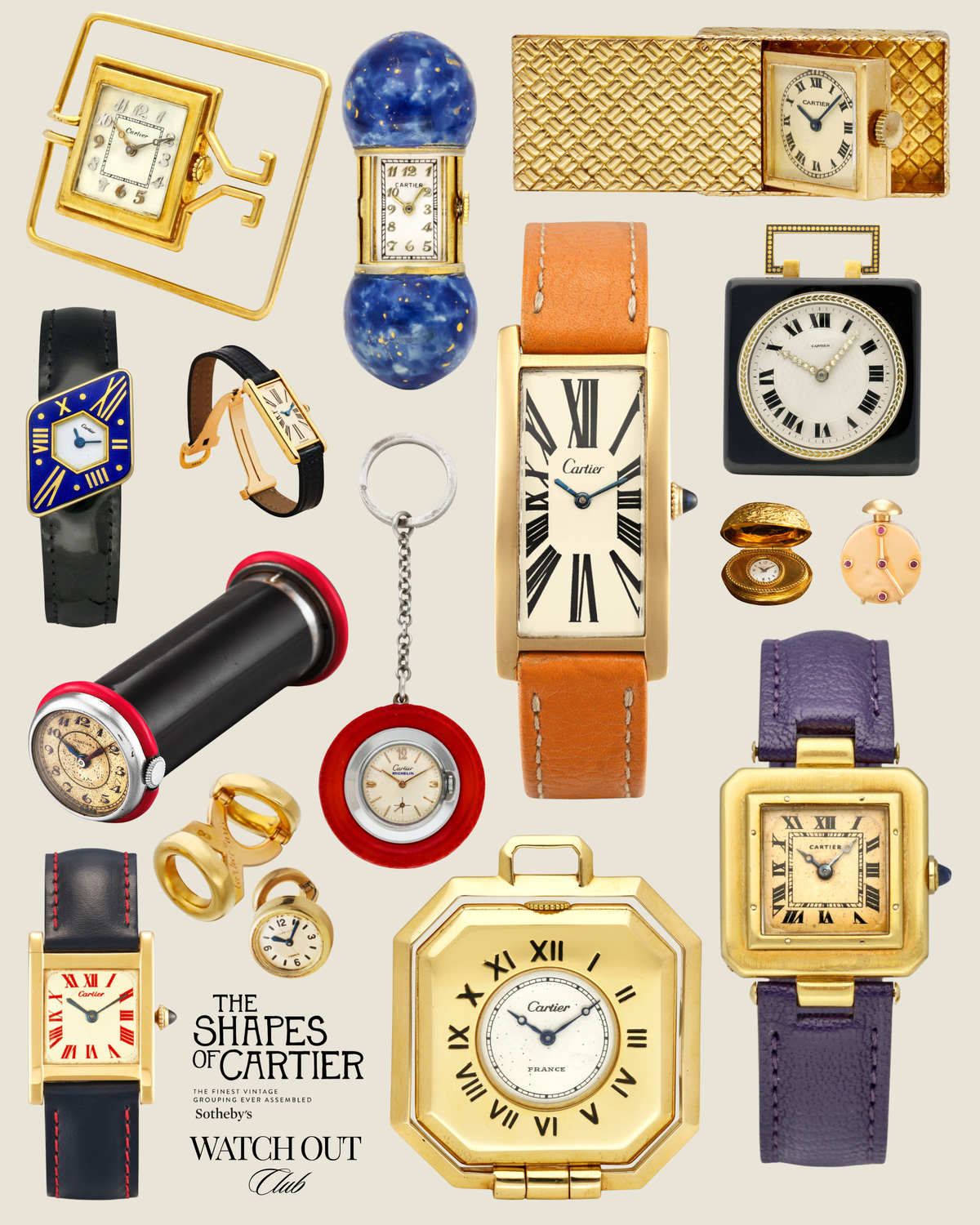
With The Shapes of Cartier, Sotheby's brings together an extraordinary private collection spanning decades of Cartier history, from early icons to some of the Maison's most unconventional creations.
Across this visual journey, we take a closer look at the collection, the watches that define Cartier's DNA, what collectors are searching for today, and the unexpected objects that reveal just how far Cartier's design language extends.

A visual introduction to the world of Cartier — where watches, jewellery, objects and design come together.

Described by collectors as one of the most important private Cartier collections ever assembled, the series brings together more than 300 historic watches.
The collection will be offered across a series of Sotheby's sales from April to December 2026, tracing decades of Cartier's creative evolution.

The Cartier DNA
Four shapes. Four icons. One unmistakable language.
Crash. Tank Cintrée. Baignoire. Tank.
Across generations, Cartier has turned the watch case into a canvas for design, playing with curves, proportions, asymmetry and geometry to create forms that remain instantly recognizable.

What Collectors Are Looking For
In Cartier collecting, not all watches are created equal.
Collectors look beyond the name on the dial. Early series, rare references, unusual shapes and Cartier London production can completely change the story, and the value, of a watch.
The most intriguing pieces are often those that sit outside the expected: unusual proportions, limited production, distinctive cases or references that reveal a different side of the Maison.
In the world of vintage Cartier, rarity is not always about complication. Sometimes, it is simply about having a shape that nobody else made.

Beyond Watches
But The Shapes of Cartier is not only about watches.
The collection also reveals the extraordinary breadth of Cartier's design language through a selection of unexpected objects, from keychains and lipstick cases to cigarette boxes and other finely crafted accessories.
These pieces offer another way of looking at Cartier: not simply as a watchmaker or jeweller, but as a house that has spent more than a century turning everyday objects into objects of desire.

A world of Cartier beyond the watch — where form, design and objects become part of the same visual language.

The Shapes of Cartier
300 historic Cartier watches brought together in one extraordinary series of sales.
A unique opportunity to explore some of the Maison's most distinctive and collectible creations.
Why Cartier Vintage Matters Now
Vintage Cartier is having a serious moment, and @sothebyswatches is proving it all year long with one of the most important private @Cartier collections ever brought to auction.
More than 300 pieces collected over 25 years, including some of the rarest Cartier references ever produced from iconic collections such as Crash London, Tank Asymétrique, Pebble, Cintrée, Tank Normale, Baignoire…
What makes this series so fascinating is that it goes far beyond the usual “grail watches”.
A huge part of the collection comes from the Cartier London years of the late ’60s and ’70s, a period when Cartier experimented with bold shapes, asymmetrical cases and proportions that still feel surprisingly modern today.
At a time when most watch brands were focused on technical performance, Cartier focused on design. Shape became the complication. Proportion became the signature.
And this is precisely what makes these watches so compelling today. They were never designed to simply follow the codes of their time, many of them were created to challenge them.
The recent sale of a Cartier London Crash for nearly $2 million already showed how strong the market has become. But this Sotheby’s series confirms something even bigger:
Collectors are no longer only buying complications or steel sports watches.
They’re buying identity, shape and emotion.